
Workshop Description
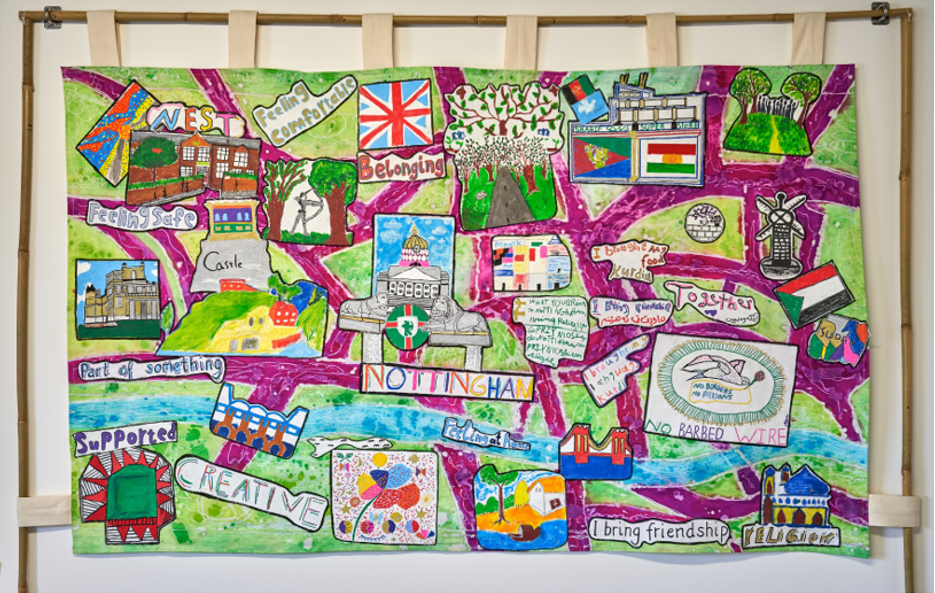
Participants will reflect on the place where they all now live and work together to create a collaborative map of the area showing the areas that are important to them.
Inspired by the city or location hosting the people in the group, and their connection to and place within it.
Workshop Aims
- To reflect on participants new home and host community, and places they have connected to within it
- To produce a collaborative, personalised map of the local area – the host community as experienced by the group collectively
Materials Required
- Paper and pens
- Extra large sheet of paper or canvas
- Small patches of paper or canvas
- Selection of materials to be used, paints, marker pens, paint pens, etc
- Glue
Workshop Activities
- On a large sheet of paper brainstorm as a group ‘where have we found Belonging here?’. Ask participants about local places they have visited, places they spend time, and spaces where they feel they fit in or can connect with their own cultures. For instance, local landmarks and places of interest, cultural venues they have visited, parks where they hang out with friends, sports stadiums and local teams, shops and restaurants selling familiar foods, places of worship, schools, and other places where they feel welcomed and connected.
- Each participant selects one or more of the places on the list to produce an illustration, making sure there is only one of each place represented across the group. It might help to have a list and ask participants to write their name besides the place they intend to illustrate. It may also be helpful to print off images of the places listed so that they can be copied rather than drawn from memory. Provide squares of paper or patches of fabric to draw or to paint a representation of each place.
- Look at maps and bird’s eye views of the city or local area. Ask a few more confident participants to work together on a large canvas or sheet of paper to sketch out a very rough, approximate outline of the layout of the area, including main roads, rivers and market places, for instance. This can be quite abstract and not true to life and will be the backdrop for the artwork.
- Use paints, spray paints, batik or another medium to fill it in the lines drawn on the large map outline. Keep the colours simple so the backdrop does not distract from the more detailed locations that will go on top of it.
- Cut around the locations produced on the patches and then spread them all out. Arrange on the map backdrop, taking time to play around with where they all go. When the group are happy with the layout they can be stuck down.
This activity can be used in any size or material, according to the time constraints and preferences of the group and lead artist.
We created a backdrop using the batik process (see workshop: Patterns in Batik) but it could easily have been made using acrylic paints, poster paints, marker pens, or spray paints.
The patches participants produced to show each location were created using acrylic paints, with details added with paint pens, but this could be done using just pencil or pens for a quicker activity.
We worked on a large canvas then hemmed it and sewed loops in the sides to allow it to be hung from bamboo poles and displayed propped against a wall or carried and processed. However a large roll of good quality paper could be used instead for quicker results.
We spent around 4 sessions creating our map as a final piece at the end of the project.
This workshop is well placed towards the end of the project, and is a useful chance to reflect on the places the group have discovered as part of their Art of Belonging journey, as well other places they connect to in their host community. Alternatively it could be started at the beginning of a project and added to as new places are discovered.
We have led this workshop in Nottingham city, which as a lot of cultural, historical and arts venues, but it can be adapted to capture any host community or new territory in the eyes of the people who have ended up there or are in transit through it.
The local natural environment, architecture, history, legends, and cultural institutions, sports’ teams and people can all be brought in.
We added words to expand on the concept of belonging, flags representing group members, and cultural input to the city from the participants themselves. This was to demonstrate that they have an important place in and contribution to the cultural life of the city, rather than being passive recipients of its hospitality.
 Art of Belonging